10. Implementation
\[\begin{split}\begin{align*}
& minimize\quad \sum_{i=1}^{N}f_{i}(x_{i}) + g(z) \\
& subject \ to \quad x_{i}-z = 0
\end{align*}\end{split}\]
10.1 Abstract Implementation
\[\begin{split}\begin{align*}
u_{i} &:= u_{i} + x_{i} - z \\
x_{i} &:= \arg\min(f_{i}(x_{i}) + (\rho/2)\|x_{i}-z+u_{i}\|_{2}^{2}) \\
z &:= \mathbf{prox}_{g, N\rho}(\bar{x} + \bar{u})
\end{align*}\end{split}\]
- Mutable states.
- Local comutation.
- Global aggregation.
- Synchronization.
10.2 MPI
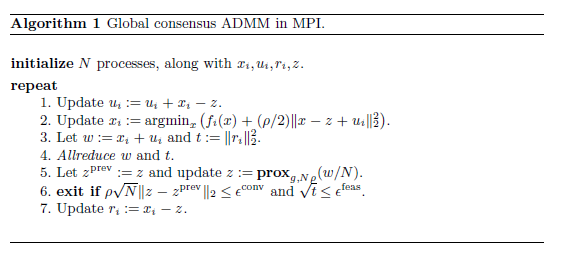
10.3 Graph Computing Frameworks
10.4 MapReduce
A MapReduce framework (or system) is usually composed of three operations (or steps):
- Map: each worker node applies the map function to the local data, and writes the output to a temporary storage. A master node ensures that only one copy of the redundant input data is processed.
- Shuffle: worker nodes redistribute data based on the output keys (produced by the map function), such that all data belonging to one key is located on the same worker node.
- Reduce: worker nodes now process each group of output data, per key, in parallel.

But MapReduce tasks are not designed to be iterative and do not preserve state in the Mappers across iterations, so the implementation requires some understanding of the underlying infrastructure.
